

The Hidden Cost of Redlining: How Black Families Can Build Generational Wealth Through Homeownership
- Brother Levon X

- 39 minutes ago
- 7 min read
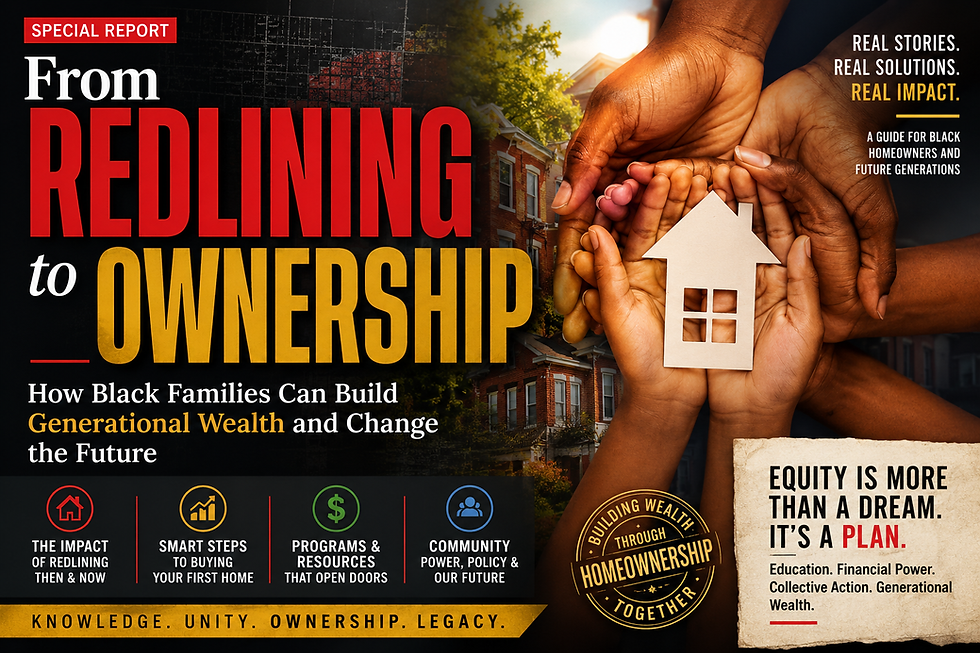
There comes a time in every generation when people must decide whether they will simply survive in a system or learn how to navigate it with wisdom, discipline, and strategy. In today's climate, where the price of homes continues to rise and economic uncertainty weighs heavily on working families, many people feel discouraged about homeownership. But despite the challenges, ownership is still one of the strongest pathways toward building stability, equity, and something meaningful to pass down to future generations.
For decades, many Black families were systematically locked out of opportunities that helped build wealth in America. One of the clearest examples was redlining, a discriminatory housing practice where banks and lending institutions denied mortgages and financial services to neighborhoods primarily occupied by Black families and other minorities. Entire communities were marked as “hazardous” simply because of race and demographics rather than the financial character of the people living there. This unfair system prevented countless families from purchasing homes, building equity, and creating generational wealth through property ownership.
The impact of those practices did not disappear overnight. Even today, many Black homebuyers continue to face barriers in the housing market through higher interest rates, appraisal disparities, and unequal access to favorable loan terms. Because the modern mortgage industry relies heavily on what is known as risk-based pricing, borrowers with lower credit scores or smaller down payments are often charged higher interest rates. Since generations of economic disadvantages have made it harder for many Black families to accumulate wealth, these conditions continue to disproportionately affect Black borrowers.
When people hear the phrase “higher interest rates,” many do not fully understand how costly that becomes over time. A lower interest rate allows more of a homeowner’s payment to go toward the principal balance of the home rather than excessive interest paid to the lender. That difference can save families tens of thousands of dollars over the life of a mortgage. This is why education is so important. Understanding how debt-to-income ratio works, learning how lenders evaluate applications, improving credit, and negotiating loan terms are all part of preparing ourselves to move wisely in the housing market.
Debt-to-income ratio, commonly known as DTI, is one of the most important numbers lenders evaluate when approving mortgages. This calculation measures how much of a person's monthly income goes toward debt obligations. The front-end ratio focuses strictly on housing expenses, while the back-end ratio includes all recurring debt such as car payments, student loans, and credit cards. The lower the ratio, the stronger the borrower appears financially. Understanding these numbers before entering the housing market gives buyers greater confidence and bargaining power.
At the same time, we must also recognize that there are opportunities and programs available today that were designed to help correct some of these historical disparities.
Special Purpose Credit Programs, known as SPCPs, were created to expand access to credit for historically underserved communities. Community Development Financial Institutions and Black-led lending organizations are also working to close the racial homeownership gap by offering more inclusive approaches to lending. In many cities, down payment assistance programs are available for first-generation homebuyers and low-to-moderate income families. These are resources that should not be ignored simply because many people are unaware they exist.
Technology has also changed the game. Information that once required hours of research inside libraries or financial offices can now be accessed from a phone or computer within minutes. There is no excuse for remaining uninformed about credit, banking, mortgages, or financial literacy when so much educational material is available. The challenge today is not access to information but rather the willingness to study, ask questions, and apply knowledge with discipline.
This is where collective bargaining and political accountability become essential. Communities that organize themselves economically and politically place themselves in a stronger position to demand fairness and transparency. Housing should not only become a conversation during election season. Local elected officials, banks, zoning boards, and city councils all influence housing access, development policies, property taxes, and neighborhood investment. When communities become educated and organized around housing issues, they gain the ability to pressure institutions into creating fairer systems.
This means supporting policies that strengthen down payment assistance programs, enforcing fair housing laws, demanding transparency in mortgage lending practices, and advocating against appraisal discrimination. It also means pushing for zoning reforms that allow working-class families greater access to affordable housing opportunities. Communities must understand that organized economic power carries influence. Politicians often respond most effectively when people are informed, united, and consistent in their demands.
Homeownership itself carries major advantages beyond simply having a place to live. A home can create equity, provide tax benefits, increase long-term financial stability, and become an appreciating asset that can later support children and grandchildren. Land ownership has historically been one of the greatest tools for wealth preservation. While markets rise and fall, land and property continue to remain central pillars in economic growth and financial leverage.
But ownership also requires preparation and maturity. Buying a home without understanding interest rates, taxes, insurance costs, maintenance responsibilities, or debt obligations can place unnecessary stress on families. This is why financial literacy must become a normal part of community education. We must normalize conversations about budgeting, saving, credit repair, investing, and ownership just as much as we discuss entertainment, sports, and politics.
The reality is that many families were never taught these principles because prior generations themselves were denied opportunities to learn and participate fully in the system. That truth should not discourage us. Instead, it should motivate us to become students of economics, banking, ownership, and community development so future generations will inherit knowledge instead of confusion.
The future belongs to people who prepare for it. Homeownership is not simply about possessing a building. It is about stability, leverage, dignity, and legacy. It is about creating a foundation where future generations can start ahead rather than constantly beginning from survival mode. Although the road may be challenging, education, discipline, collective action, and strategic planning can help transform obstacles into opportunities.
In today's time, ownership matters. Knowledge matters. Unity matters. And the more we educate ourselves on finance, housing, politics, and economics, the better positioned we become to protect our communities and build something lasting for those who come after us.
Many people automatically run to major banks when it’s time to buy a home because that’s what society has conditioned us to do. But one thing our community must start understanding is that credit unions can sometimes offer a better path toward homeownership, especially for working-class families trying to build stability and generational wealth. A credit union is often more community-focused, while large banks are usually driven heavily by shareholders and corporate profit. That difference alone can impact how people are treated during the loan process.
Credit unions are member-owned institutions, which means their goal is often centered more around serving the people who bank with them instead of maximizing profits at every turn. Because of that structure, many credit unions tend to offer lower fees, lower interest rates, and more personal relationships with loan officers. In many cases, they are willing to actually sit down and educate borrowers instead of simply pushing paperwork across a desk.
One of the biggest advantages of using a credit union is flexibility. Large banks often rely strictly on computerized formulas and rigid lending systems. Credit unions may still evaluate your finances carefully, but some are more willing to look at the full picture of your situation instead of only focusing on a number on a screen. For first-time homebuyers, especially those working to improve credit or save for a down payment, that personal approach can make a major difference.
Another important point is interest rates. One of the greatest mistakes people make when purchasing a home is not understanding the danger of adjustable-rate mortgages. A lot of buyers get excited because the beginning payment looks lower, but later the interest rate can rise, causing the monthly mortgage payment to jump significantly. This can place families in financial stress and even lead to foreclosure if income changes or inflation increases.
This is why it is extremely important to fight for a fixed-rate mortgage whenever possible. A fixed-rate loan locks your interest rate in for the life of the loan, giving you stability and predictability. Your principal and interest payment remain steady instead of fluctuating with the market. That consistency allows families to better budget, build equity, and protect themselves long-term. In our community, financial stability matters more than chasing temporary deals that can later become traps.
Before signing any mortgage paperwork, people must slow down and ask questions. Too many families walk into loan offices intimidated or unprepared. There is nothing wrong with respectfully asking lenders to explain every detail. This is a business transaction that can impact your family for decades.
Some important questions to ask include:
“What is the exact interest rate and is it fixed or adjustable?”
“What will my monthly payment look like with taxes and insurance included?”
“Are there any hidden fees or penalties?”
“What credit score is needed to qualify for the best rate?”
“Do you offer down payment assistance programs or first-time homebuyer programs?”
“How much money will I pay in interest over the life of the loan?”
“Can I buy points to lower my interest rate?”
“What debt-to-income ratio do you require?”
“Will private mortgage insurance be required, and when can it be removed?”
“What programs exist for first-generation or underserved homebuyers?”
These questions are important because knowledge protects people from being taken advantage of. The more educated we become on lending, contracts, credit, and real estate, the more power we have when negotiating. Never allow anyone to rush you into signing documents you do not fully understand.
Homeownership should not just be viewed as having a roof over your head. It should be viewed as part of a larger strategy toward ownership, stability, and legacy. A home can create equity, tax advantages, and long-term financial leverage. Land and property have historically been some of the greatest tools for preserving wealth and creating opportunities for future generations.
At the same time, we have to remain disciplined. Just because a lender approves someone for a certain amount does not always mean that amount is financially wise. Sometimes people qualify for homes that stretch their budget too thin. A smart homeowner thinks beyond just getting approved. They think about maintaining peace, stability, and flexibility in their finances.
This is why financial literacy is so important in today's time. We must learn how banking works, how interest works, how credit works, and how to negotiate wisely. We can no longer afford to move blindly when it comes to ownership and economics. The more we educate ourselves, the stronger position we place our families and communities in for generations to come.
References
U.S. Department of Housing and Urban Development (Fair Housing)
Consumer Financial Protection Bureau (Mortgage and Lending Resources)
Federal Reserve Bank Research on Housing and Wealth Gaps
National Community Reinvestment Coalition
The Fair Housing Act Overview
Community Reinvestment Act Information (FDIC)
Black Wealth Data Center
National League of Cities Housing Programs


Comments